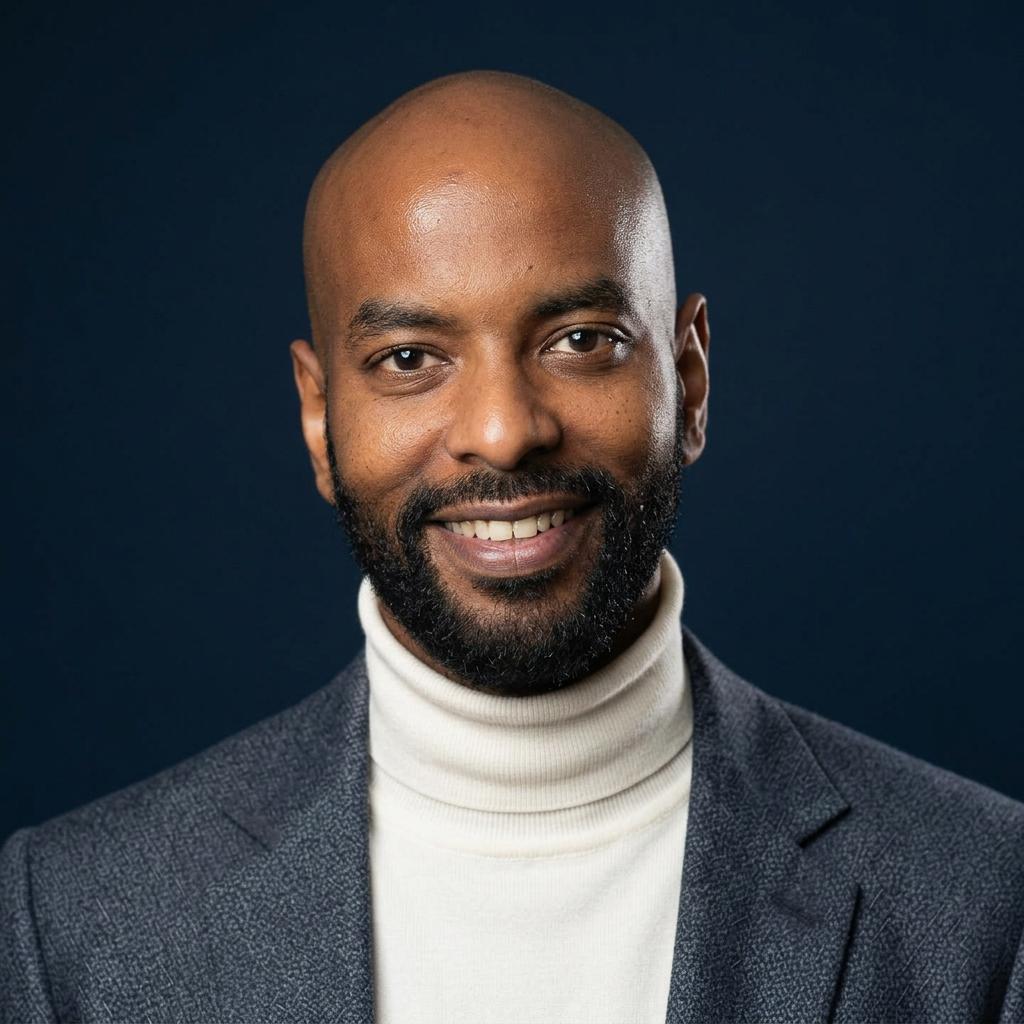
For seventeen years I have done the same work under different names. I built a hip-hop media network that reached a million users. I helped launch a global transmedia art venture. I ran pharma transformation programs at Merck and Johnson & Johnson. Now I run an integrated AI strategy practice serving regulated enterprises.
The industries change. The work does not.
What holds it together is a single question: how do you make a system humans actually trust? Whether the system is a UN draft resolution, a million-user online community, a pharma go-to-market program, or a fleet of on-prem AI agents inside a federal contractor, the work is the same. Shape the incentives. Design who decides. Build something the people inside it can defend.
This portfolio is a walk through that spine. Current work up top. The chapters that trained me for it below.
Forward-deployed engagements with leadership to design the operating model, governance, and human-in-the-loop systems that let AI move from pilot to production. I work inside the team, not from a deck across the table.
The practice is built around The Decision-Rights Map, a proprietary framework that surfaces the operating-model failure modes enterprises typically miss before they deploy. It grew out of my executive MBA thesis on data bias in AI. Most AI programs do not stall on the model. They stall on who is allowed to decide what the model produces.
Pharos delivers forward-deployed AI agents for the enterprise: production-grade systems deployed on-prem, governed, auditable, and under human control. I co-founded the company and lead strategy, positioning, and enterprise engagement.
We built it for regulated industries, where on-prem deployment is the condition for having AI at all. Federal, financial services, healthcare, and defense buyers cannot send their data somewhere else, so the product goes to them. I set the market-entry approach and anchored our federal engagement on an operational-excellence use case.
Working in those sectors means designing to a compliance context rather than around it. I structure deployments so they can be evidenced against the regimes our clients answer to, including NIST 800-53, CMMC, FIPS 140-2, HIPAA, GDPR, and the EU AI Act, and I do that alongside their security and compliance teams rather than in place of them.
Director in a domain-expert network supporting emerging-technology ventures across infrastructure, hardware, AI, and defense. I sit with founders and CEOs on governance, operating model, and the story their capital markets need to hear.
My current focus is Ionetix, a particle-accelerator company advancing toward public listing via reverse merger. Across advised ventures, the work has contributed to more than $50M raised since January 2026.
Director of Strategic Development at a non-profit studying the future of organizations and how they lead across boundaries. I contributed to intellectual programming and executive forums on what AI does to organizational structure and to the job of leading.
What does an advisor actually do at the moment a deep-tech venture crosses from private capital to public markets? The technology is already proven. What is not yet built is the governance a public shareholder will price: who decides, who signs, what gets reported, and how the company explains itself when the diligence starts.
I contributed to investor-grade materials, supported governance reviews, and framed the operating model with the founder and CEO as the company prepared its reverse-merger path. This is my strongest current-tense credential, and the one closest to how I want to work: technical clients, real consequences, decisions that outlive the engagement.
Two of the largest pharmaceutical companies in the world, both trying to change how they went to market, both bounded by regulation that makes improvisation expensive. I led transformation programs at MSD (Merck) and Janssen-Cilag (Johnson & Johnson) across Primary Care, Oncology, and Business Operations.
We piloted five data-driven market-entry strategies for primary-care brands and put agile and omnichannel methods into teams that had never worked that way. This is where I learned that in regulated environments the constraint is never the idea. It is whether the operating model can carry it.
In 2009 nobody knew what a YouTube business was. I co-founded Redframe and built one, from zero: negotiated YouTube Partnership funding for original programming, became an Official YouTube Partner and a Google Creative Media Service Provider, and built one of the first multi-channel networks by working directly with creators on growth, monetization, and channel management.
Seven-figure revenue in year one. A community past a million users. A Grimme Online Award for the content itself. More than a hundred brand partnerships funded spin-offs including 16bars TV, which became Germany's leading hip-hop media platform. I exited in 2015. The pattern I use now started here: build the incentives first, and the audience follows.
You have decided AI matters to your business, but your operating model or governance cannot yet absorb it.